
Technical and fundamental analysis of the Australian dollar/US dollar pair (AUD/USD)
Overview: The Australian dollar/US Dollar (AUD/USD) pair is trading at levels of 0.6575-0.6580 ⁇ New low ⁇ after a sharp reversal followed by Australian inflation data. Australian Bureau of Statistics data showed inflation rose to 4.9% a year in October from 4.3%...
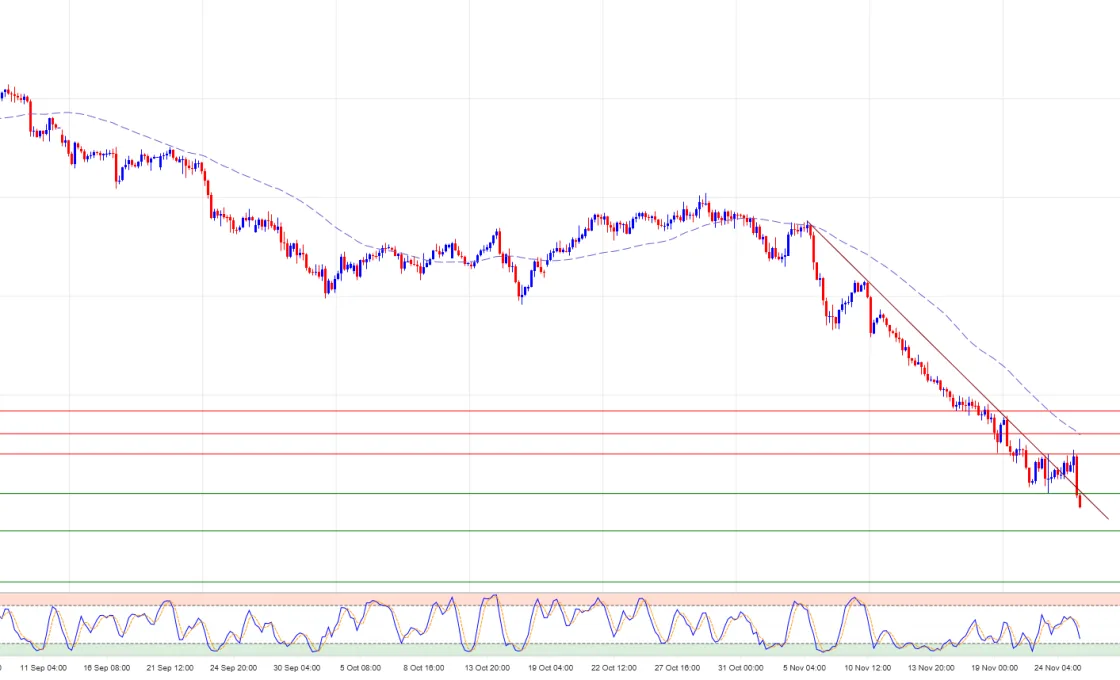
The overview:
The Australian dollar/US Dollar (AUD/USD) pair trades at levels of 0.6575-0.6580 ⁇ New low ⁇ after a sharp reversal following Australian inflation data. Australian Bureau of Statistics data at dawn today showed inflation rising to 4.9% annually in October from 4.3%, while the cut-off average ⁇ the Reserve Bank’s preferred measure ⁇ accelerated to 3.8% from 3.6% (forecast 3.6%), and rose 0.5% monthly against a forecast of 0.3%. And electricity prices jumped 25.2% a year. The Australian immediately jumped to 0.6660, but reversed sharply and broke the bottom of 0.6597. ⁇ ️ Follow-up: US PCE and GDP ⁇ today 16:30 AM Amman time, and the Australian Reserve Bank decision on 8 December.
The technical analysis:
Through the attached chart on the four-hour time frame, we observe that the pair jumped with data up to the resistance of 0.6659 ⁇ at the downtrend line ⁇ where it was precisely rejected, then dropped a long red candle breaking the support of 0.6597 and the possible double bottom (0.6600-0.6610), all the way to 0.6576 ⁇ new low. The classic “selling the news” pattern: jump on data and then a strong reversal. 0.6597 ⁇ Broken support ⁇ Turned into first resistance. The stochastic index at 27.83/43.89 drops below sales saturation after ⁇ room for more. The next target is 0.6539, then 0.6459.
The basic analysis:
Inflation is high ⁇ But the market believes jobs: inflation exceeds expectations and the cut-off average is further away from the target range (2-3%), which in theory keeps the risk of additional raising. But the central bank removed in a November statement its warning of possible additional hikes, and the job shock (unemployment 4.9%) is likely to stabilise. In other words: the bank faces a dilemma ⁇ high inflation and weak labor market ⁇ and the market is betting that unemployment will prevail. Add to that a strong dollar before PCE. Bottom line: A negative reflection on positive data ⁇ a clear sign of weakness for the currency.