
Technical and fundamental analysis of the Australian dollar/US dollar pair (AUD/USD)
Overview: The AUD/USD pair trades at the levels of 0.6715-0.6725, testing support for 0.6727 from below after breaking slightly. Ironically, Australian wage data came out stronger than expected this morning: the wage index rose 1.1% in...
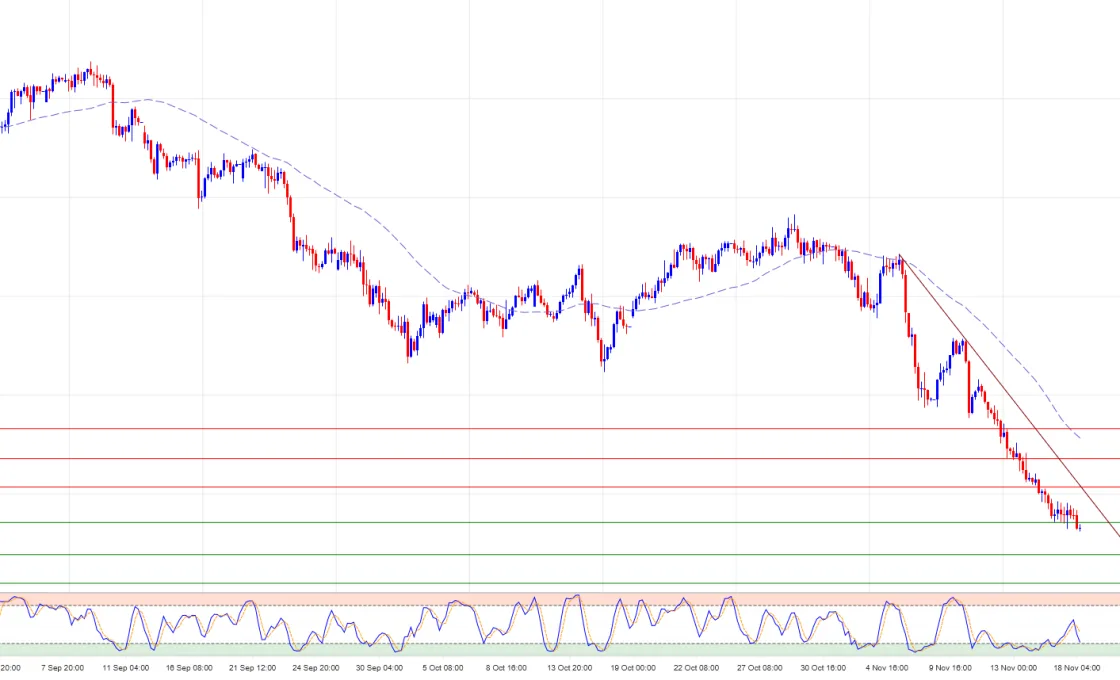
The overview:
The AUD/USD pair trades at the levels of 0.6715-0.6725, testing support for 0.6727 from below after breaking slightly. Ironically, Australian wage data came out stronger than expected this morning: the Wage Price Index rose 1.1% in the third quarter ⁇ the fastest quarterly pace since the end of 2023 ⁇ and annual growth was 3.5% versus a forecast of 3.4%. And yet the Australian is declining. The pair is trapped between the resistance of 0.6727-0.6797 and the support of 0.6691-0.6659. Follow-up: The federal calendar tonight (22:00 am Amman time), and the Australian labour market at dawn on Thursday 19 November (03:30 AM Amman time).
The technical analysis:
Through the attached chart on the four-hour timeframe, we observe that the pair held for more than a day around 0.6727 with a very weak reversal of only ~0.6745, then returned to a red candle drop to 0.6721. Grip above the support and then break ⁇ continuing downward pattern. The price is below the sharp downtrend line from a peak of 0.7020, and well below the sloping moving average near 0.6815. The Stochastic Index at 22.36/38.33 reversed downward after a brief rebound. Closing four hours below 0.6720 confirms the break and opens 0.6691 then 0.6659. 0.6766 remains the main resistance with the trend line.
The basic analysis:
Stronger wages ⁇ and the market doesn’t believe in a new raise: Usually, accelerating wages boost interest rate bets and support the currency. But the details undermine the reading: growth was driven by Fair Work Commission decisions ⁇ including a 4.75 percent increase in the minimum wage ⁇ and public sector increases, which are one-time factors. Wages have also lagged behind inflation for four consecutive quarters – a decline in real purchasing power. Experts say the threshold for a new RBI raise is too high after a 6-3 split. In other words, the market doesn’t see wages as a sufficient incentive to reverse forecasts of stagnation while the federal accelerates. Bottom line: The trend is down, and Thursday morning’s business data is the last Australian test this week.